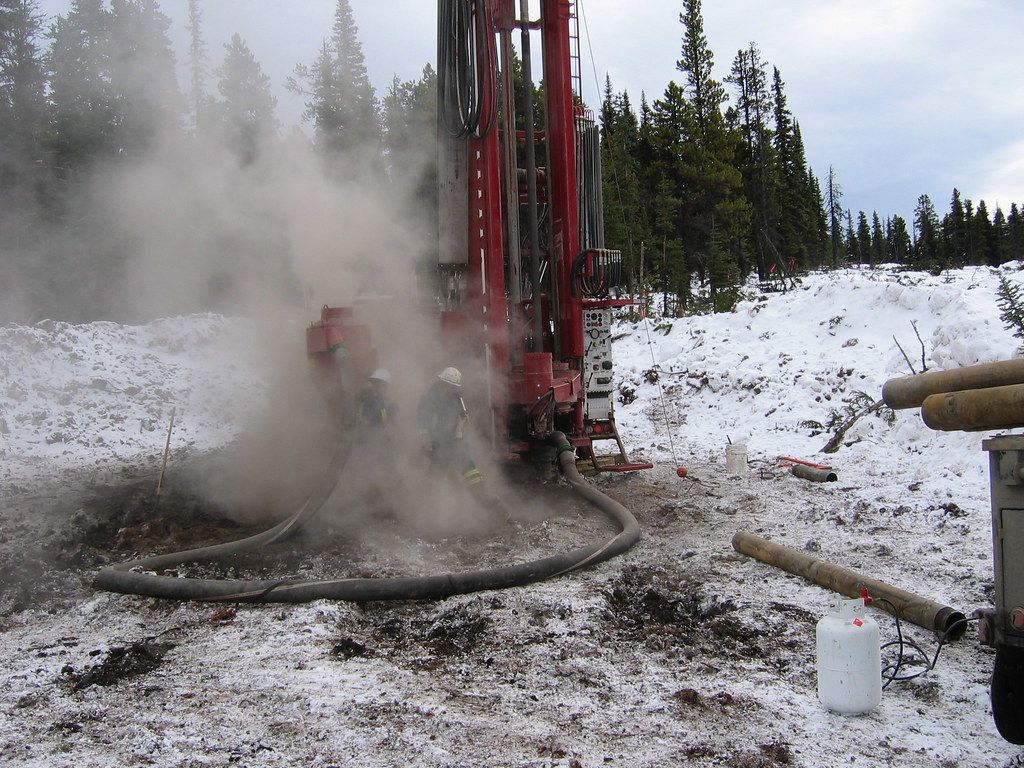
Geotechnical engineering plays a vital role in various construction projects, providing critical information about subsurface conditions. One of the fundamental activities in geotechnical investigations is drilling, which allows engineers to collect soil and rock samples, evaluate groundwater levels, and determine the stability of the ground. In this blog, we will delve into the different drilling methods available to geotechnical engineers, highlighting their advantages, disadvantages, and appropriate applications.
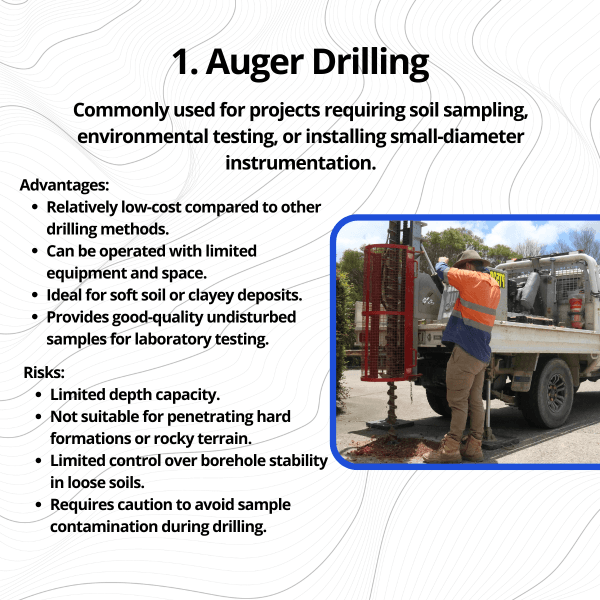
Auger drilling involves the use of a rotating helical screw blade to extract soil or other materials. This method is suitable for shallow investigations and is commonly employed for geotechnical projects requiring soil sampling, environmental testing, or installing small-diameter instrumentation.
Advantages:
- Relatively low-cost compared to other drilling methods.
- Can be operated with limited equipment and space.
- Ideal for soft soil or clayey deposits.
- Provides good-quality undisturbed samples for laboratory testing.
Disadvantages:
- Limited depth capacity.
- Not suitable for penetrating hard formations or rocky terrain.
- Limited control over borehole stability in loose soils.
- Requires caution to avoid sample contamination during drilling.
Appropriate Applications:
- Environmental site assessments.
- Small-scale foundation investigations.
- Monitoring well installation.
- Soil sampling for laboratory analysis.
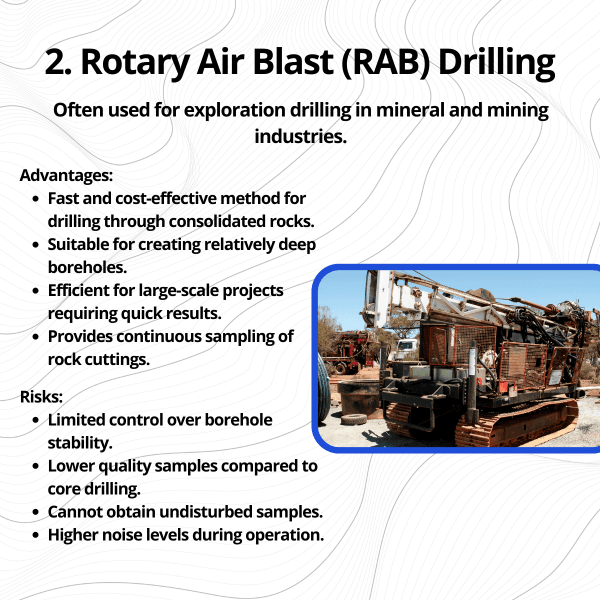
RAB drilling employs compressed air to operate a down-the-hole hammer, which continuously strikes the rock surface, dislodging cuttings and creating boreholes. This method is often used for exploration drilling in mineral and mining industries.
Advantages:
- Fast and cost-effective method for drilling through consolidated rocks.
- Suitable for creating relatively deep boreholes.
- Efficient for large-scale projects requiring quick results.
- Provides continuous sampling of rock cuttings.
Disadvantages:
- Limited control over borehole stability in unconsolidated or fractured rock formations.
- Lower quality samples compared to core drilling.
- Cannot obtain undisturbed samples.
- Higher noise levels during operation.
Appropriate Applications:
- Mineral exploration.
- Initial site investigations in rocky terrains.
- Preliminary groundwater assessment.
- Geochemical and geophysical testing.
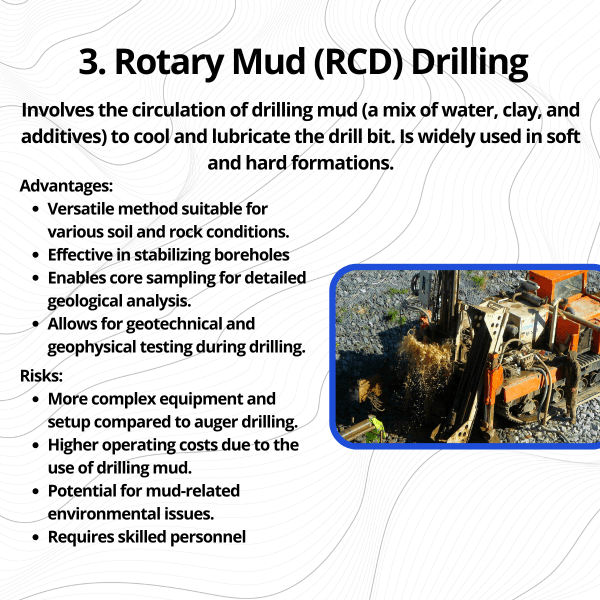
Rotary mud drilling involves the circulation of drilling mud (a mixture of water, clay, and additives) to cool and lubricate the drill bit. The mud also carries cuttings to the surface, providing continuous sampling. This method is widely used in both soft and hard formations.
Advantages:
- Versatile method suitable for various soil and rock conditions.
- Effective in stabilizing boreholes and minimizing collapse in unconsolidated formations.
- Enables core sampling for detailed geological analysis.
- Allows for geotechnical and geophysical testing during drilling.
Disadvantages:
- More complex equipment and setup required compared to auger drilling.
- Higher operating costs due to the use of drilling mud.
- Potential for mud-related environmental issues.
- Requires skilled personnel for managing mud circulation.
Appropriate Applications:
- Foundation investigations.
- Soil and rock characterization.
- Groundwater monitoring.
- Detailed geological studies.
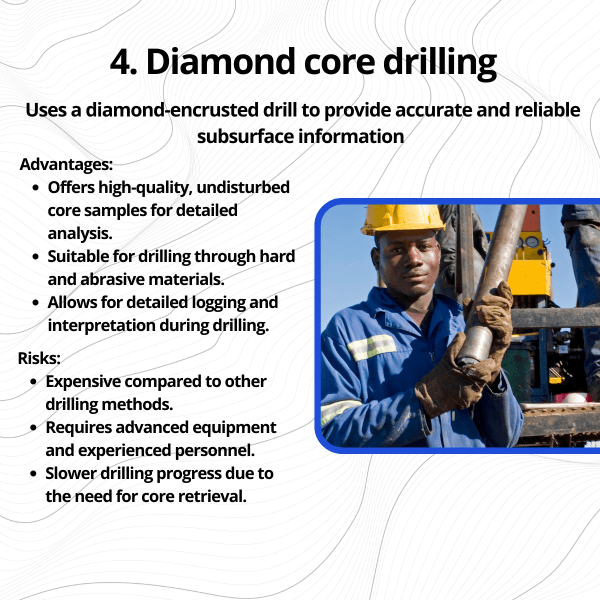
the most accurate and reliable subsurface information, making it a preferred choice for detailed geotechnical investigations.
Advantages:
- Offers high-quality, undisturbed core samples for detailed analysis.
- Suitable for drilling through various rock formations, including hard and abrasive materials.
- Precise determination of rock strength, fracture orientation, and mineral composition.
- Allows for detailed logging and interpretation during drilling.
Disadvantages:
- Expensive compared to other drilling methods.
- Requires advanced equipment and experienced personnel.
- Slower drilling progress due to the need for core retrieval.
- Involves more logistical challenges for site operations.
Appropriate Applications:
- Comprehensive geotechnical investigations.
- Foundation design for critical structures.
- Detailed rock characterization for tunneling or dam construction.
- Mining and oil exploration.
There are several less common geotechnical drilling methods that are used in specific situations where conventional drilling techniques may not be suitable. Here are a few examples along with their advantages, disadvantages, and when each method should be used:
1. Sonic Drilling
Advantages: Sonic drilling uses high-frequency vibrations to break up soil and rock, resulting in minimal soil disturbance and intact core samples. It is faster than conventional drilling methods and generates less waste. Disadvantages: Sonic drilling is more expensive than traditional drilling techniques. It is also limited to softer formations and may encounter difficulties in hard rock. When to use: Sonic drilling is ideal for environmental and geotechnical investigations, particularly in contaminated sites where minimal soil disturbance is required. It is also useful for sampling in cohesive soils or unconsolidated formations
2. Pressuremeter Testing:
Advantages: Pressuremeter testing measures in situ soil properties, such as the modulus of deformation, shear strength, and stress-strain behavior. It provides detailed information about the soil's mechanical properties. Disadvantages: The equipment required for pressuremeter testing is specialized and expensive. The test can be time-consuming and may not be suitable for all soil types. When to use: Pressuremeter testing is commonly employed in geotechnical engineering projects, such as foundation design, slope stability analysis, and underground excavations, to determine the mechanical properties of the soil
3. Cone Penetration Testing (CPT) with Seismic Dilatometer (SDMT):
Advantages: CPT with SDMT combines the cone penetration test with a seismic dilatometer, providing simultaneous measurement of cone resistance, pore pressure, and shear wave velocity. It offers valuable data for assessing soil behavior and liquefaction potential. Disadvantages: CPT with SDMT requires specialized equipment and expertise. It may encounter difficulties in certain soil conditions, such as gravels or dense sands. When to use: This method is useful in geotechnical investigations related to liquefaction potential, soil behavior, and ground response analysis, particularly in seismic zones.
4. Electro-Hydraulic Rotary Drilling (EHRD): Advantages: EHRD is a versatile drilling method that combines high-frequency vibrations and hydraulic power to break up rock formations efficiently. It provides high-quality core samples and allows for real-time monitoring and control of drilling parameters. Disadvantages: EHRD equipment can be expensive and requires skilled operators. It may not be suitable for very hard rock formations. When to use: EHRD is beneficial in mining and geotechnical applications, especially for obtaining intact core samples in hard rock formations. It is also useful in geothermal drilling projects.
Choosing the most appropriate drilling method for a geotechnical project is crucial for obtaining accurate and reliable subsurface data. Auger drilling, RAB drilling, rotary mud drilling, and diamond core drilling each offer distinct advantages and disadvantages. By considering the specific project requirements, soil/rock conditions, and budgetary constraints, geotechnical engineers can select the most suitable drilling method to gather the necessary information for successful project planning and design. Remember, selecting the right drilling method is the first step toward ensuring a solid foundation for any construction endeavor.