Environmental decisions are only as strong as the data behind them.
That point has come back into sharp focus following the U.S. Environmental Protection Agency’s announcement that previously submitted groundwater test results from East Palestine, Ohio were found to be inconsistent with split-sample testing and did not meet data quality standards.
For environmental engineers, this is more than a headline about one site. It is a reminder of how critical defensible data is in contaminated land investigations, groundwater monitoring programs, and long-term remediation work.
A quick recap of the issue
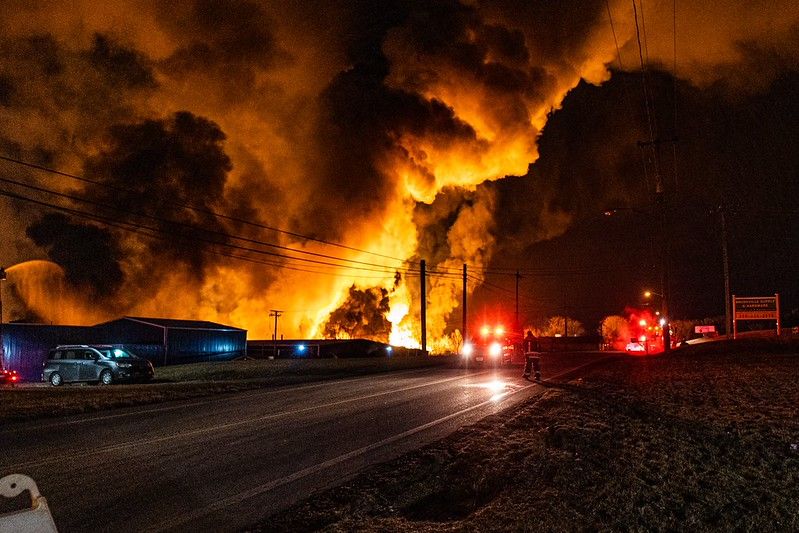
The EPA recently announced that a subcontracted laboratory involved in groundwater sampling in East Palestine had submitted alarming results that were later found to be unreliable. The issue related to sampling carried out in fall 2025 near the site of the Norfolk Southern train derailment that occurred on February 3, 2023.
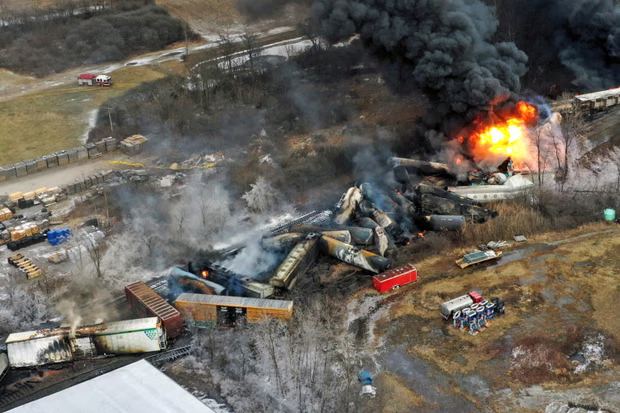 Debris from a Norfolk Southern freight train lies scattered and burning along the tracks in East Palestine, Ohio, on 4 February 2023. Photograph: Gene J Puskar/AP
According to the agency, the subcontractor had previously reported detections of 2-butoxyethanol in groundwater samples. However, EPA Region 5 identified inconsistencies when those results were compared against split samples analysed by other laboratories. Tetra Tech later notified the EPA that the measurements had been altered, resulting in false sampling data. The EPA stated that the corrected results indicated no groundwater contamination in that round of testing and no risk to the public or the environment from those findings.
The two analysts involved were reportedly terminated after failing to follow standard operating procedures.
Why environmental engineers should pay attention
At first glance, this might seem like a laboratory compliance issue. In reality, it highlights something much broader: the entire environmental decision-making process relies on trustworthy, traceable data.
Groundwater results can influence a wide range of outcomes, including:
- risk assessments
- remediation strategies
- regulatory reporting
- stakeholder communication
- long-term monitoring decisions
- community confidence
When data is later found to be inaccurate or manipulated, the consequences can be significant. Even if the corrected results show no risk, trust can still be damaged, project teams may need to repeat work, and confidence in the wider investigation can be weakened.
For environmental professionals, that makes data integrity just as important as the fieldwork itself.
Why split sampling matters
One of the most important details in this case is how the discrepancy was discovered.
The questionable results did not match split-sample data sent to other laboratories. That comparison helped flag the issue and led to further investigation.
For environmental engineers, this is a practical reminder that split sampling can be an essential quality assurance measure, especially when:
- results are unexpected
- concentrations appear unusually high
- public concern is elevated
- regulatory scrutiny is strong
- the site has a high-profile contamination history
Split sampling is not always necessary on every project, but in high-stakes situations it can provide a valuable cross-check that strengthens confidence in the final interpretation.
Data quality is a full-project responsibility
It is easy to think of data quality as something owned by the lab alone. In reality, environmental data moves through a chain of people, systems, and decisions.
Field teams collect the samples. Project managers coordinate handling and logistics. Laboratories prepare and analyse the samples. Engineers review the outputs and use them to support conclusions that may affect remediation plans, reporting obligations, and public messaging.
That means data integrity should be treated as a whole-of-workflow responsibility.
Environmental engineers play a key role in that chain by questioning anomalies, comparing new results against historical trends, reviewing qualifiers and case narratives, and ensuring the final interpretation is technically defensible.
Lessons for contaminated land and groundwater projects
The East Palestine case is a strong reminder that robust environmental work depends on more than collecting samples and receiving laboratory certificates. It depends on confidence in the full path from field collection to final reporting.
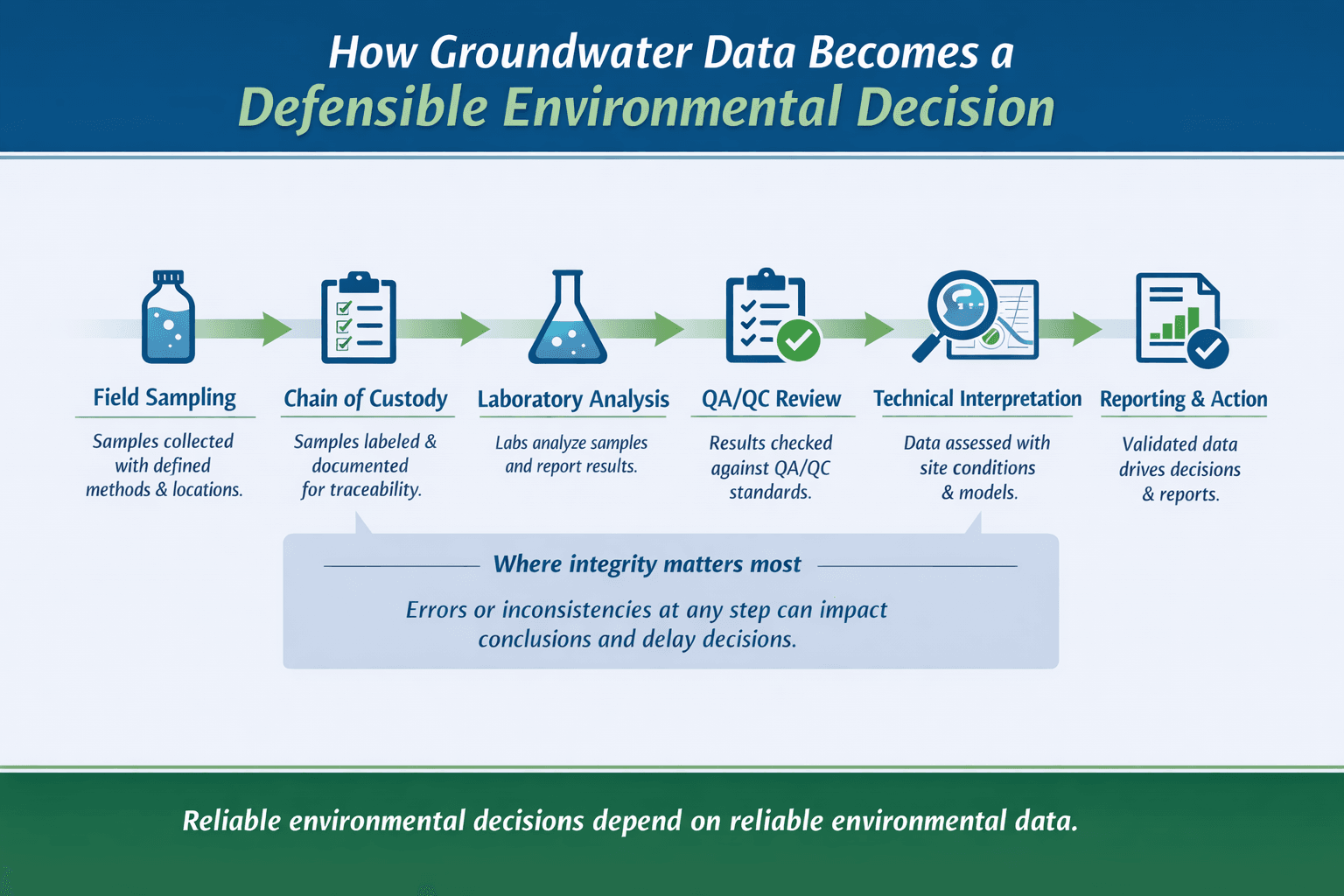
Some of the most important safeguards include:
1. Strong QA/QC planning before sampling starts
Quality assurance should begin well before a sample reaches the lab. Sampling plans should clearly define objectives, analytical methods, duplicates, blanks, split samples where needed, and acceptance criteria for data review.
2. Careful review of laboratory outputs
Environmental teams should not treat lab reports as unquestionable. Reviewing qualifiers, checking for anomalies, and comparing results across rounds can help identify issues early.
3. Cross-checking unusual results
Unexpected detections should be evaluated in context. Do they align with site history, known contaminant sources, groundwater flow patterns, and other lines of evidence? If not, they may warrant verification.
4. Clear documentation and traceability
Defensible environmental reporting requires transparent records across chain of custody, analytical methods, data validation, and reporting decisions.
5. Systems that support accountability
The more fragmented the workflow, the harder it becomes to trace where something went wrong. Consistent digital recordkeeping and structured data management can reduce the risk of confusion, version errors, and poor auditability.
The trust factor
There is also a wider lesson here around public trust.
Sites like East Palestine are already under intense scrutiny. Communities want confidence that the data informing health and environmental decisions is accurate. When test results are later found to be false, even if corrected quickly, it can create confusion and fuel concern.
That is why transparency matters just as much as technical correctness. Identifying a problem, investigating it properly, and clearly communicating the corrected findings are all part of maintaining credibility.
For environmental engineers, especially those working on public-facing projects, trust is not built by promising perfect outcomes. It is built by showing that systems are in place to verify results, catch errors, and respond appropriately when issues emerge.
Final thoughts
The EPA’s update may have reassured the East Palestine community that the groundwater results in question did not indicate contamination. But the broader takeaway for the environmental sector remains important.
Reliable environmental decisions depend on reliable environmental data.
For environmental engineers, that principle sits at the centre of site investigations, risk assessments, remediation planning, and long-term monitoring. Cases like this are a reminder that technical rigour is not just about what is sampled, but how thoroughly the resulting data is verified before conclusions are drawn.