New technical findings released as part of the investigation into the fatal 2025 Nesvatnet landslide in Norway are giving geotechnical engineers an important opportunity to reflect on construction-stage risk.
The recently published assessment points to lime-cement pile installation, combined with hidden permeable layers in the subsurface, as the trigger for the failure. For engineers involved in rail, road, embankment, and soft ground projects, the findings reinforce a critical lesson: the temporary condition during stabilisation can be just as dangerous as the ground being treated.
While the broader investigation remains ongoing, the technical assessment already offers valuable insight into how temporary weakening, pore pressure build-up, and incompletely understood subsurface conditions can combine to create catastrophic failure during ground improvement works.
A stabilisation method that became the trigger
Lime-cement piles are widely used to strengthen soft ground. Once cured, they can significantly improve the strength and stiffness of weak soils. But as the newly released findings from Nesvatnet make clear, the installation process itself can introduce serious short-term risk if the ground model does not fully capture how the subsurface will respond.
On 30 August 2025, a quick clay landslide struck near Levanger in Norway while lime-cement piles were being installed to reinforce the ground for rail works. Around 170 metres of the Nordlandsbanen railway line and 100 metres of the E6 motorway were swept away. Four people were caught in the slide, and one worker lost their life.
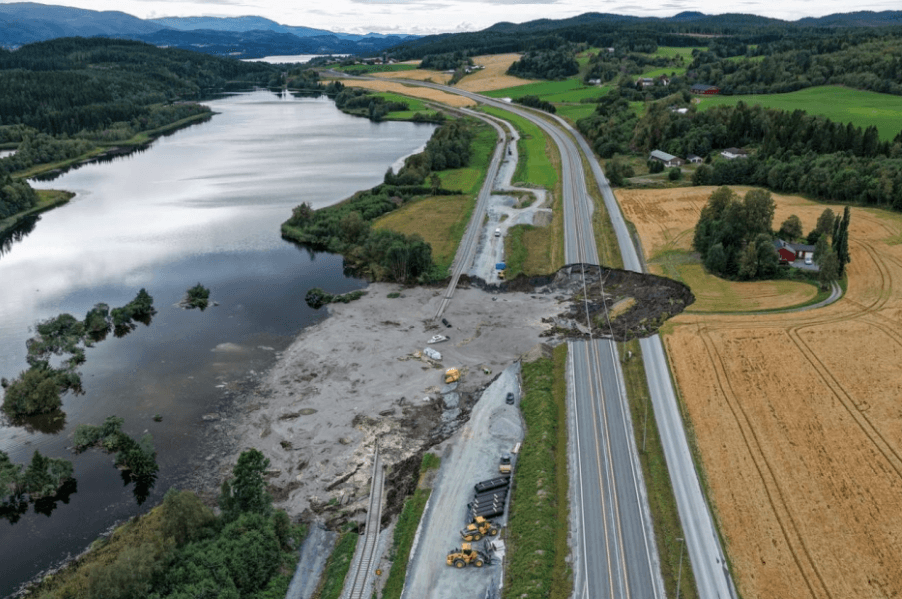 Landslide view and extent at Nesvatnet near Levanger. Source: Inquirer (image by Ole Martin Wold/NTB Scanpix via AP)
According to the technical assessment, the stabilisation works underway at the time appear to have pressurised a permeable layer embedded within the clay deposit. That layer, believed to be sand or silt, was located about six metres below the surface. Investigators concluded that air pressure associated with pile installation likely entered this layer and raised pore pressures rapidly enough to trigger failure.
This is what makes the case so significant. The problem was not simply the long-term performance of the stabilised ground. It was the short-lived but highly unstable condition created during installation.
Why these findings matter now
The newly released assessment is especially relevant because it shifts the conversation beyond the landslide itself and toward a broader engineering issue: whether construction-stage geotechnical risk is being treated with enough rigour in sensitive ground conditions.
Ground improvement is usually framed as a risk reduction measure. But the findings from Nesvatnet show that for some methods, the path to a safer end state can itself create instability if certain geological features are overlooked or not fully understood.
That distinction matters.
For geotechnical engineers, this is a reminder that temporary conditions deserve just as much scrutiny as final design outcomes. Construction sequencing, installation pressures, local stratigraphic complexity, and transient pore pressure response can all become central to the stability problem.
Four lessons engineers can take from the Nesvatnet findings
1. Construction-stage stability must be assessed in its own right
One of the clearest takeaways from the technical findings is that the act of stabilising the ground can temporarily make it less stable.
Lime-cement piles ultimately improve weak soils, but installation disturbs the existing structure of the clay before that strength gain occurs. If that disturbed zone is larger than expected, or if pressure is transmitted into a susceptible layer, the consequences can be severe.
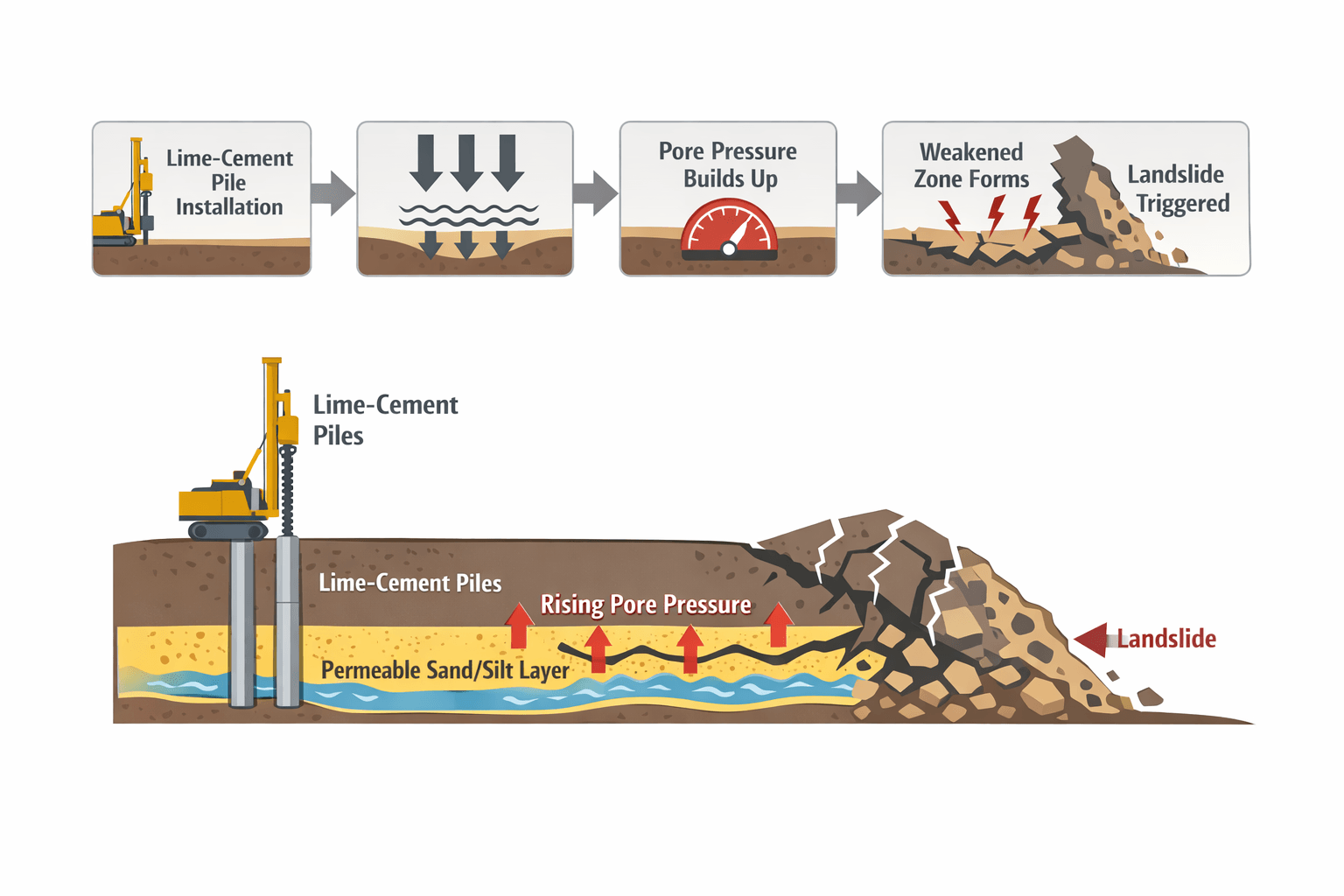 Conceptual diagram of the proposed failure mechanism at Nesvatnet, where lime-cement pile installation increased pressure within a permeable subsurface layer and contributed to local instability and landslide initiation.
Projects in sensitive ground should be asking:
What happens to stability during installation, not just after curing? How large is the temporary weakened zone between adjacent treatment elements? Could installation sequence, pile spacing, or productivity rates alter the risk profile?
2. Hidden permeable layers can control the failure mechanism
A major insight from the assessment is the role played by a permeable layer within the clay deposit. Although boreholes had identified the layer near the eventual failure zone, its continuity and extent were not fully understood before the slide.
That is a critical reminder for practitioners. Thin seams of sand or silt may appear secondary in a broad geological model, but under the wrong conditions they can become the main pathway for pressure transfer and instability.
In layered ground, the most dangerous feature is not always the dominant unit. Sometimes it is the partially defined layer between boreholes that changes everything.
3. Monitoring only helps if it targets the right layer
The site reportedly included monitoring equipment, but the sensors were installed in the clay rather than in the permeable layer considered critical to the triggering mechanism.
That makes this more than a story about instrumentation. It is a story about matching monitoring design to the most credible failure mode.
Instrumentation can create confidence, but only if it is measuring the ground behaviour that actually matters. For projects involving sensitive clay and pressurised installation methods, that means thinking carefully about sensor location, target strata, and whether monitoring is capable of capturing rapid changes in the critical layer.
4. Geological uncertainty remains a major project risk during construction
The Nesvatnet case is a strong reminder that uncertainty does not disappear once construction starts. In many cases, that is when it becomes most consequential.
Ground investigation data is always incomplete. Interpretation fills the gaps. But where failure depends on how pressure moves through subtle subsurface features, those gaps can carry major consequences.
This does not mean every site needs an unrealistic level of investigation. It means investigation strategies need to be aligned with the real failure mechanisms that could emerge during the construction process, not just with the final design assumptions.
A broader question for the industry
The recent findings from Nesvatnet also raise a larger issue for the geotechnical sector: are current stabilisation practices always robust enough for complex, layered, and sensitive subsurface conditions?
That question is not limited to Norway.
Any project involving soft clays, transport corridors, staged embankment works, or ground treatment under pressure should take notice. The combination of incomplete subsurface interpretation, installation-induced disturbance, and unobserved transient pressure response is not unique to one site.
That is why construction methodology cannot be treated as a secondary detail. In some projects, it is central to the stability challenge.
What geotechnical teams should take forward
The value of a newly released technical assessment like this lies not in hindsight criticism, but in helping the industry sharpen its thinking before similar works are undertaken elsewhere.
For designers, contractors, and reviewers, the findings suggest a need to:
- analyse construction-stage stability separately from final conditions,
- interrogate whether hidden permeable layers could alter pore pressure behaviour,
- make sure instrumentation targets the most critical strata,
- and test whether the ground model is detailed enough for the chosen stabilisation method.
The latest findings from Nesvatnet are a timely reminder that when the goal is to make weak ground safer, understanding how the ground behaves during treatment is just as important as understanding how it will behave once treatment is complete.