Every region logs boring data a little differently — different classification systems, different fields, different presentation conventions. Below are ready-to-use boring log templates for the most common standards, plus copy-and-paste versions you can drop straight into a spreadsheet if you're not ready to move to dedicated logging software yet.
Free Copy-and-Paste Boring Log Templates
Prefer to start in a spreadsheet? These are the same field structures used above, laid out as plain tables you can paste directly into Excel or Google Sheets. Each one is built around a different regional standard, so pick the one that matches your project's classification system.
US Template (ASTM D2487 / D2488 Aligned)
Borehole header fields:
| Field | Example |
|---|---|
| Borehole_ID | BH-01 |
| Project_ID | 23-123 |
| Date_Start | 2026-03-05 |
| Coordinate_System | State Plane, NAD83 |
| Easting | 1234567 |
| Northing | 7654321 |
| Datum | NAVD88 |
| Surface_Elev | 102.4ft |
| Drilling_Method | HSA |
| Driller | ABC Drilling |
| Logger | DJ |
Interval table fields:
| From_Depth | To_Depth | Material_Description | Visual_ID_USCS | Lab_USCS | Moisture | Density_Or_Consistency | Color | Structure | Cementation | Boundary_Type | Notes |
|---|---|---|---|---|---|---|---|---|---|---|---|
| 0.0 | 25 | Sandy SILT with trace gravel | ML | ML | moist | firm | brown | massive | none | clear | fill suspected in top 0.5 ft |
Why this layout: ASTM D2488 covers visual-manual description and identification; it's standard practice to log a D2487 symbol in the field as a visual-manual estimate, then update it once lab results confirm the classification.
UK Template (BS 5930 Aligned)
Borehole header fields:
| Field | Example |
|---|---|
| Borehole_ID | BH-03 |
| Grid_Ref | TQ 12345 67890 |
| Datum | OS datum |
| Ground_Level | 31.2m |
| Investigation_Purpose | Foundation assessment |
| Method | Cable percussion |
| Logged_By | DJ |
Interval table fields:
| From_m | To_m | Description | Strength_Or_Consistency | Moisture | Fabric_Or_Structure | Discontinuities | Groundwater_Notes | Samples | Notes |
|---|---|---|---|---|---|---|---|---|---|
| 0.0 | 1.2 | Made Ground: sandy gravel with brick fragments | dense | moist | heterogeneous | none | seepage noted at 1.1 m | Bulk S1 | variable |
Why this layout: BS 5930 is the UK code of practice for ground investigations, and it places more emphasis on linking the investigation's purpose and context to the material record than the US format typically does.
International Template (US, Canada, UK)
For teams working across borders, this template keeps one consistent schema and adds a Regional_Terms notes field rather than changing the data structure per country.
Borehole header fields:
| Field | Example |
|---|---|
| Borehole_ID | BH-07 |
| Country | Canada |
| Units | m |
| Coordinate_System | UTM Zone 10N |
| Datum | CGVD2013 |
| Surface_Elev | 54.8 |
| Drilling_Methods | Rotary wash |
| Standard_References | ASTM D2488, ASTM D2487, CAN/BNQ 2501-140 |
Interval table fields:
| From | To | Material_Description | Field ID_System | Field_ID_Symbol | Lab_Class_System | Lab_Class_Symbol | Test_Ref | SPT_Blows | SPT_N | Groundwater | Boundary_Type | Notes |
|---|---|---|---|---|---|---|---|---|---|---|---|---|
| 0.0 | 1.2 | Made Ground: sandy gravel with brick fragments | dense | moist | heterogeneous | none | seepage noted at 1.1 m | Bulk S1 | variable | x | x | x |
TabLogs Boring Log Template Examples
These are real templates built in TabLogs, shown here so you can see what a finished, standards-aligned log looks like before you build your own.
AS 1726:2017 Standards (Australia)
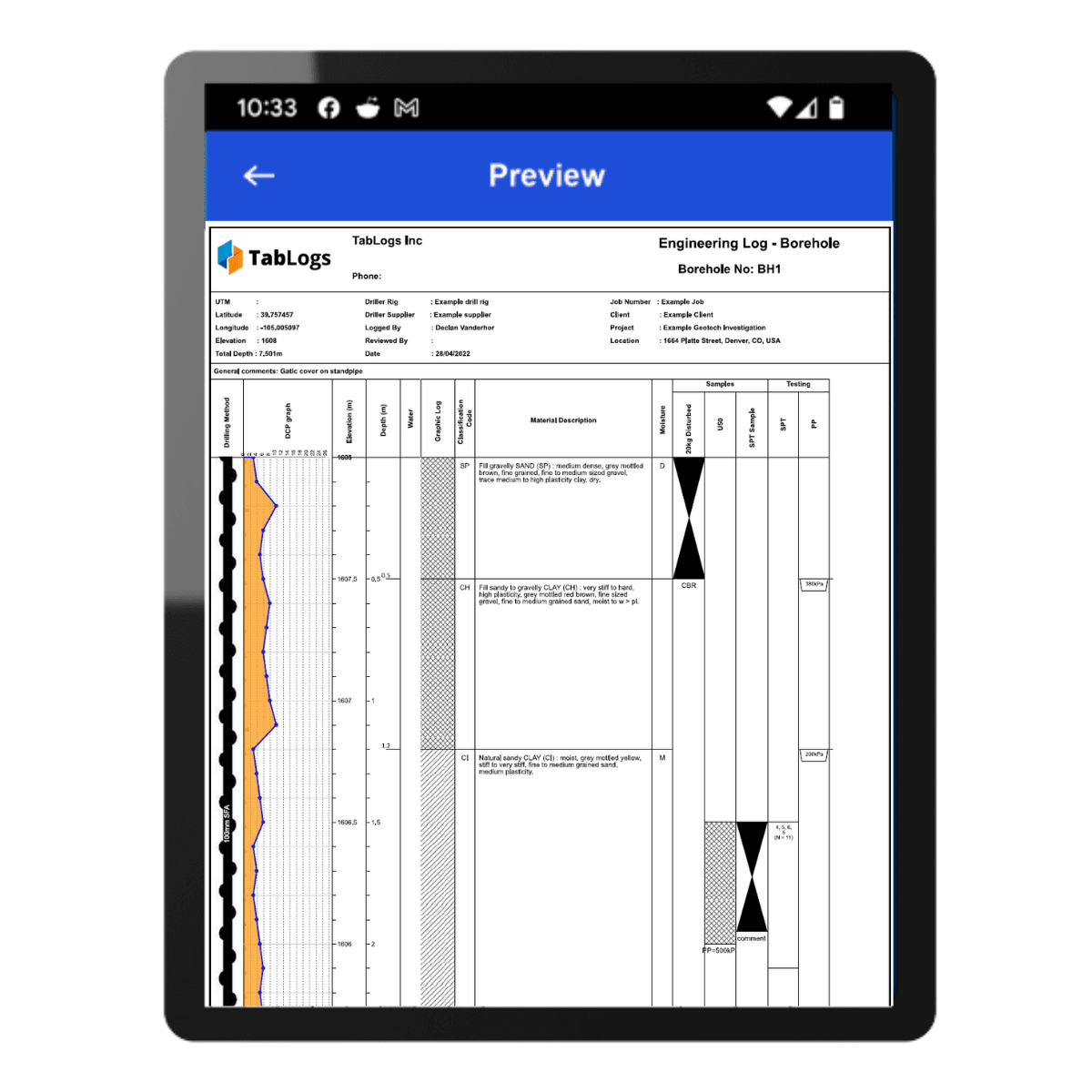
Borehole Log Template #1
This log template includes a DCP graph, a drilling method graphic, material descriptions, samples, and testing methods.
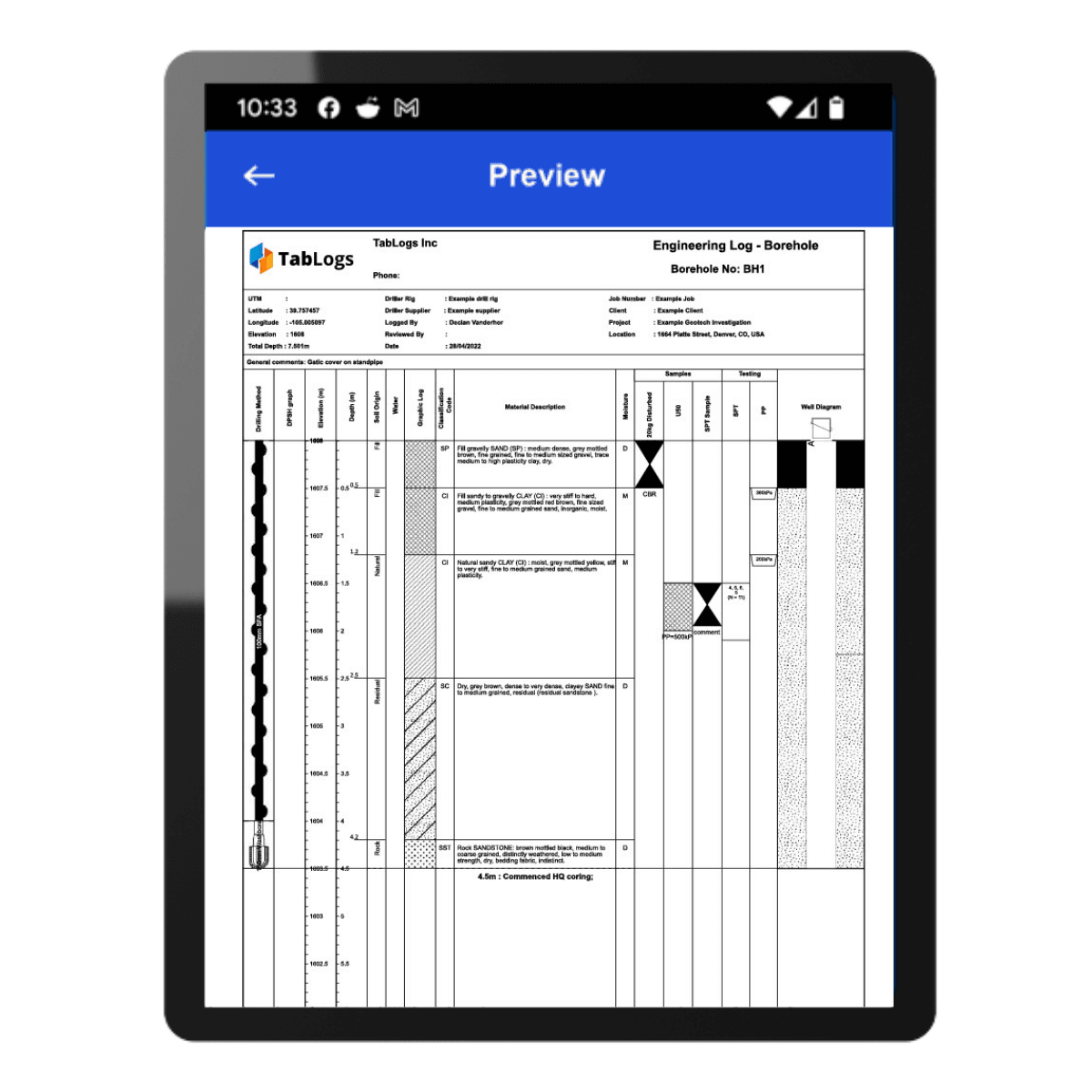
Borehole Log Template #2
This log template includes a drilling method graphic, graphic logs, material descriptions, samples, testing methods, and well diagrams.
ASTM D2487 Standards (United States)
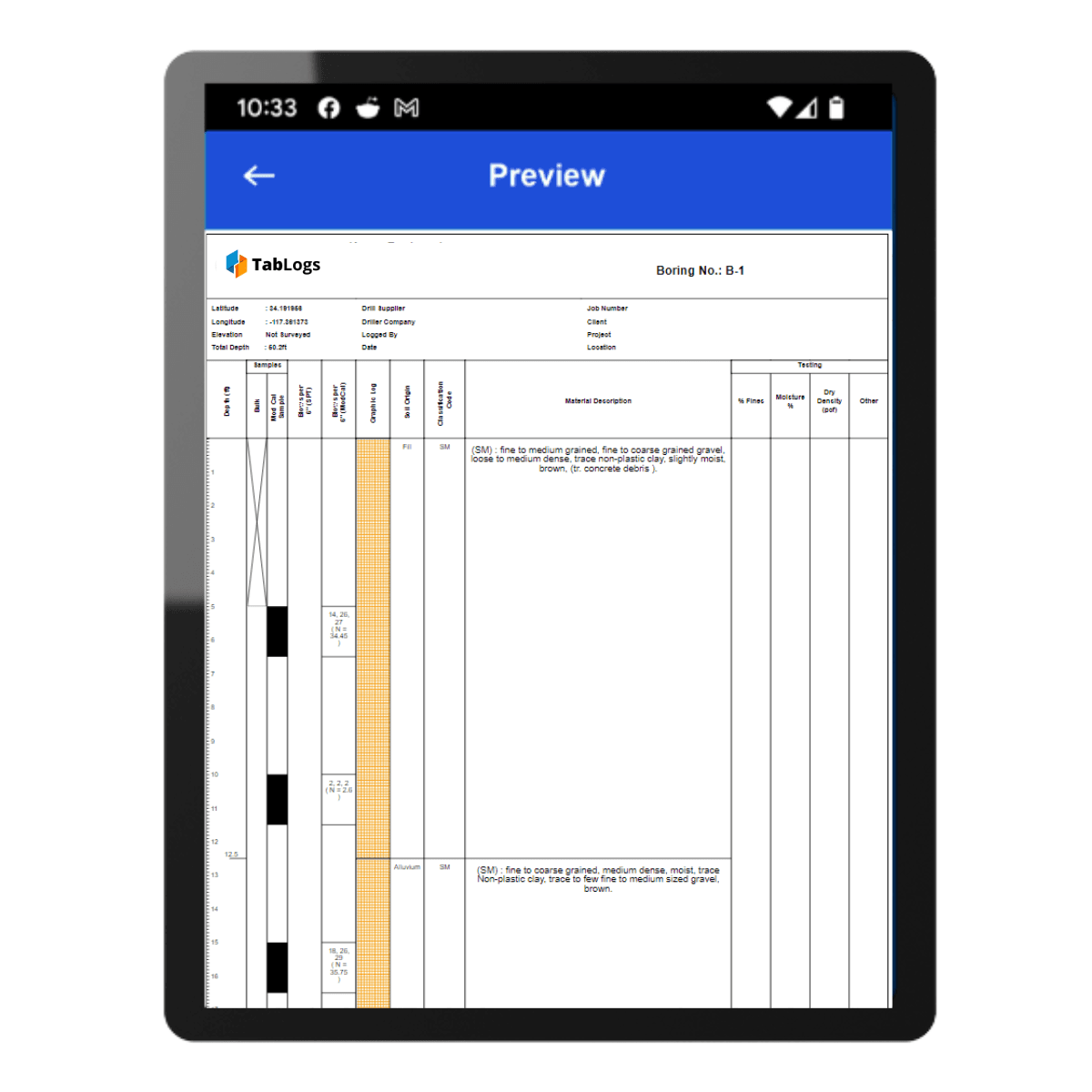
Borehole Log Template #1
This log template includes samples, SPT and ModCal blows, soilorigin, classification codes, material testing comments, and testing information.
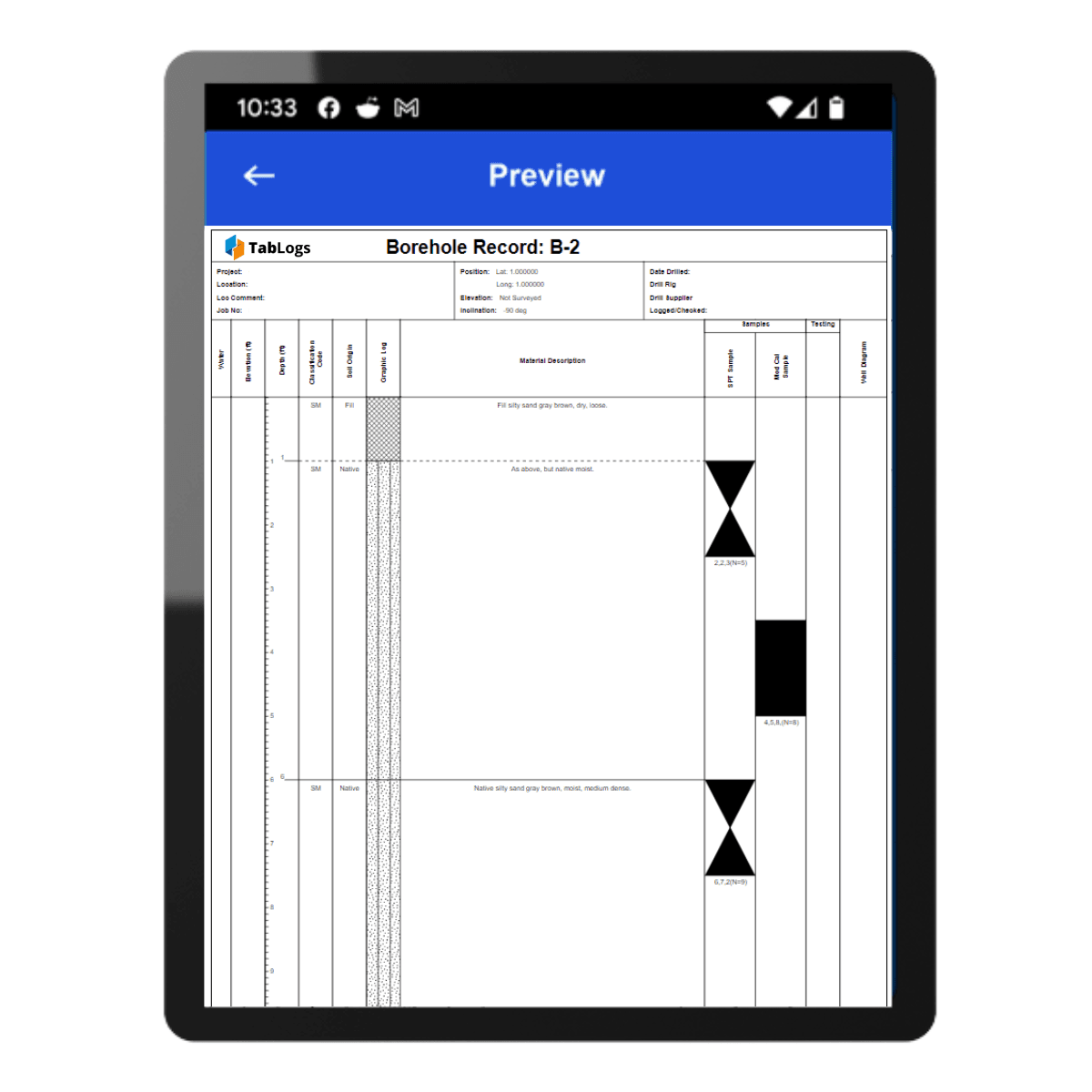
Borehole Log Template #2
This log template includes water, SPT and ModCal samples, soilorigin, classification codes, material testing comments, andtesting information.
Which Template Should You Use?
- Working on a US project under ASTM D2487/D2488? Use the US template.
- Working under BS 5930 in the UK? Use the UK template.
- Running projects across multiple countries, or want one schema you can map to any region later? Use the international template. It's also the easiest to import into TabLogs directly if you decide to move off spreadsheets.
For a full breakdown of how these standards differ — including a single soil layer logged three different ways — see our Boring Log Standards Compared guide.
FAQ
Is there a free boring log template?
Yes. The templates above are free to copy into a spreadsheet. They're built around ASTM, BS 5930, and international field schemas so you can start standardising logs immediately, without needing to build a template from scratch.
Can I use these templates in Excel?
Yes. Each template is laid out as a plain header/field table, so it pastes cleanly into Excel or Google Sheets as two tables: borehole header fields and interval/depth fields.
What's the difference between a boring log template and a borehole log template?
Nothing meaningful for most projects. "Boring log" and "borehole log" are used interchangeably in the US and Canada, while "borehole log" is more common in UK and Australian usage. The field structure is the same regardless of which term your firm uses.