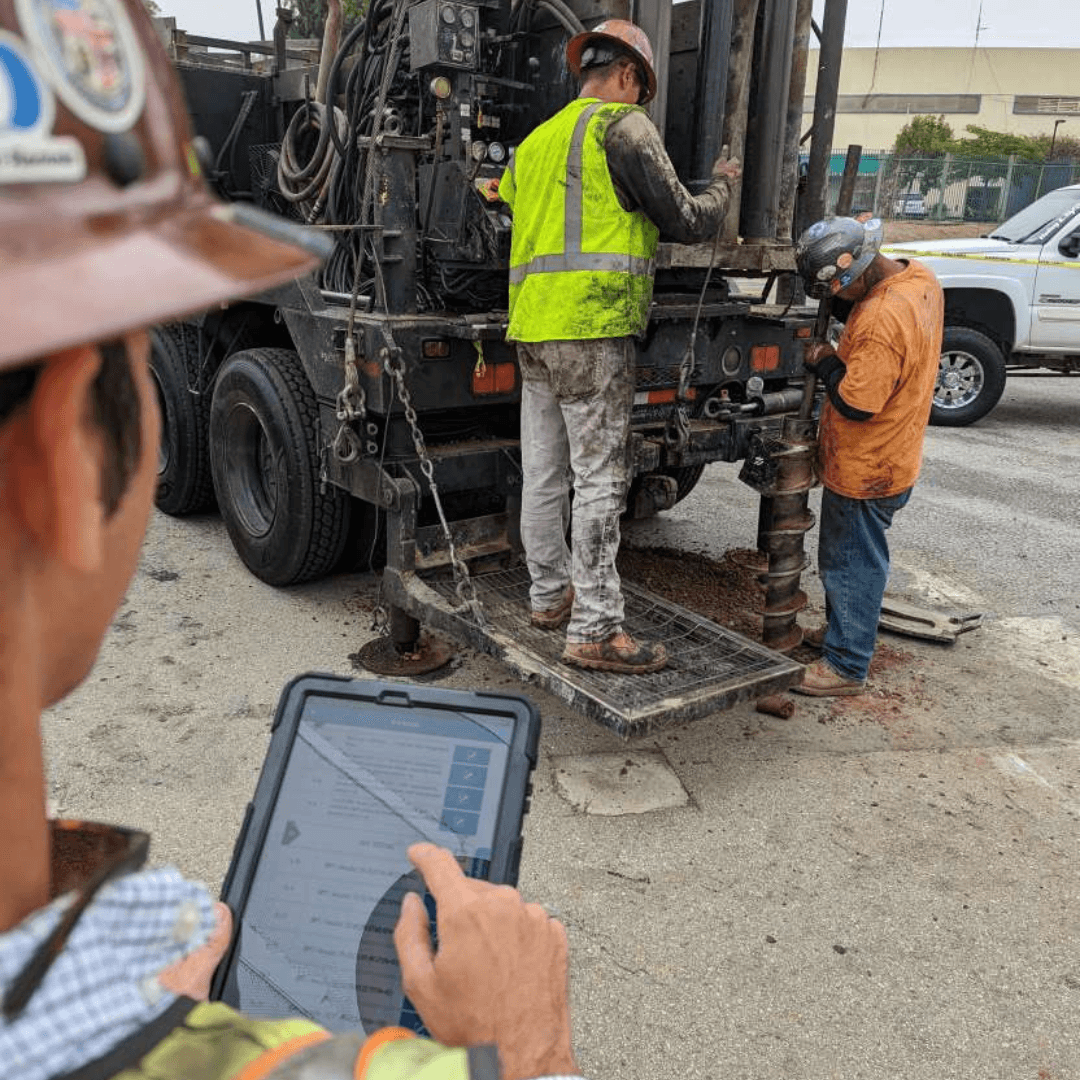
Soil boring is the process of drilling a borehole into the ground to collect soil samples and subsurface data for engineering, environmental, or construction projects. It's one of the most common methods of subsurface exploration, used to determine soil type, density, moisture content, and layering before a structure, road, or foundation is designed. The data collected during a soil boring is recorded in a boring log, which becomes a core reference document for the project's geotechnical report.
Common Soil Boring Methods
Not all soil borings are drilled the same way. The method a driller chooses depends on soil conditions, groundwater depth, required sample quality, and project budget. The three most common methods are:
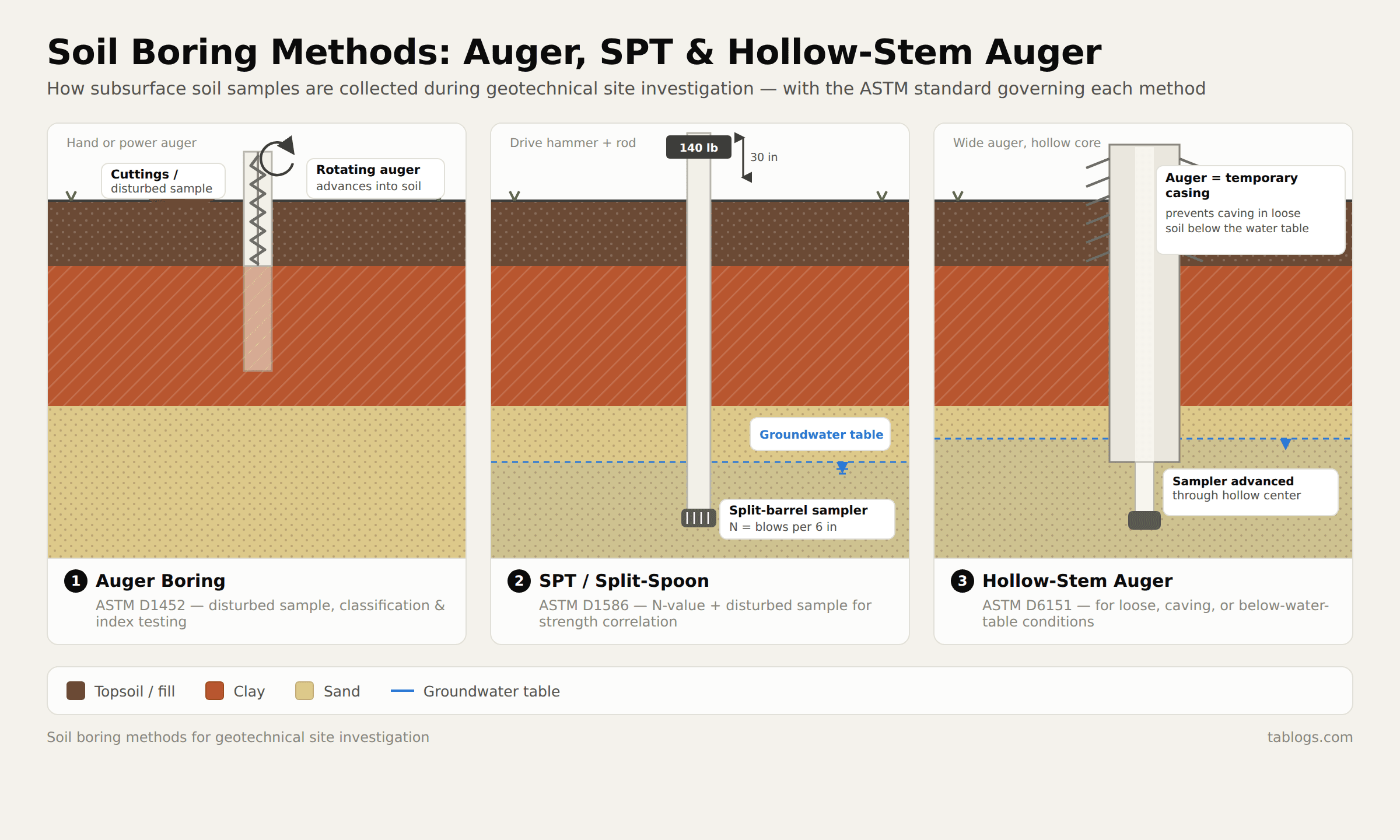
Auger boring. A rotating auger, either a hand auger for shallow, low-budget work or a power auger mounted on a drill rig, advances into the ground and brings disturbed soil to the surface for classification. Auger boring is fast and economical, and it's the standard approach for shallow investigations in cohesive soils above the water table. Because the sample is disturbed, it's suitable for soil classification and index testing but not for undisturbed strength testing.
Split-spoon sampling (Standard Penetration Test, or SPT). A split-barrel sampler is driven into the soil at the bottom of the borehole using a 140 lb hammer dropped 30 inches, and the number of blows required to drive the sampler in 6-inch increments is recorded as the "N-value." The N-value correlates with soil density and strength, making SPT one of the most widely used in-situ tests in geotechnical practice. It also recovers a small disturbed sample for visual classification and lab index testing.
Hollow-stem auger (HSA) drilling. A hollow-stem auger acts as a temporary casing, allowing samplers (such as a split-spoon or thin-wall tube) to be advanced through the center of the auger without having to remove it from the hole. This makes HSA drilling well suited to loose or caving soils and below-water-table conditions where an open borehole would collapse. It's also a common choice for environmental borings where a temporary monitoring well may be installed afterward.
Governing Standards
Soil boring in the US is governed by a small set of ASTM standards that most geotechnical firms, regulators, and reviewing engineers reference by number:
- ASTM D1452/D1452M — Standard Practice for Soil Exploration and Sampling by Auger Borings. Covers procedures and equipment for exploring and sampling soil with hand and power augers, producing disturbed samples suitable for classification and index testing. It does not cover hollow-stem augers, which fall under ASTM D6151/D6151M.
- ASTM D1586/D1586M — Standard Test Method for Standard Penetration Test (SPT) and Split-Barrel Sampling of Soils. Defines the hammer weight, drop height, drive increments, and blow-count procedure used to perform SPT and recover split-barrel samples, along with the N-value used in geotechnical design correlations.
Referencing the correct standard in a boring log and site investigation report isn't just a formality, it tells the reviewing engineer, contractor, or regulator exactly how the sample was obtained, so the data can be trusted and reproduced.
Why Accurate Soil Boring Logs Matter
The boring itself is only half the job. The value comes from how well the resulting data is logged. A soil boring log records the sequence of soil and rock layers encountered, sample depths and types, N-values, moisture and groundwater observations, and field classifications, and it becomes a primary input into the geotechnical report that engineers use to design foundations, retaining structures, and earthworks.
Errors or inconsistencies in a boring log don't stay contained to the field, they propagate into the report, the design, and ultimately the constructed project. A misread depth, a missed groundwater strike, or an inconsistent classification between two drillers on the same site can lead to under-designed foundations, disputed change orders, or costly rework once construction is underway. Accurate, standardized logging is what makes a site investigation report defensible and useful long after the drill rig has left the site.
How TabLogs Digitizes Soil Boring Data Capture in the Field
Traditional boring logs are still often recorded on paper in the field and re-typed back at the office, a process that introduces transcription errors and slows down reporting. TabLogs replaces that workflow with a mobile, button-based interface that lets field technicians log soil type, sample depth, N-values, and groundwater observations directly on a tablet or phone, with built-in validation that flags inconsistent or out-of-range entries in real time. Because logs are captured digitally and offline-capable, data syncs automatically once a connection is available, and it flows straight into a standardized, ASTM-aligned report. No re-typing, no lost field sheets, and a consistent format across every driller and every site. For firms managing multiple crews or high borehole volumes, that consistency is what keeps QA/QC time down and reports defensible.
Related Reading
- Boring Log Standards Compared: US, UK, and Canada: how boring logs and formats differ across the US, UK, and Canada, and how to standardize across them.
- Free boring log templates (US, UK & Canada)