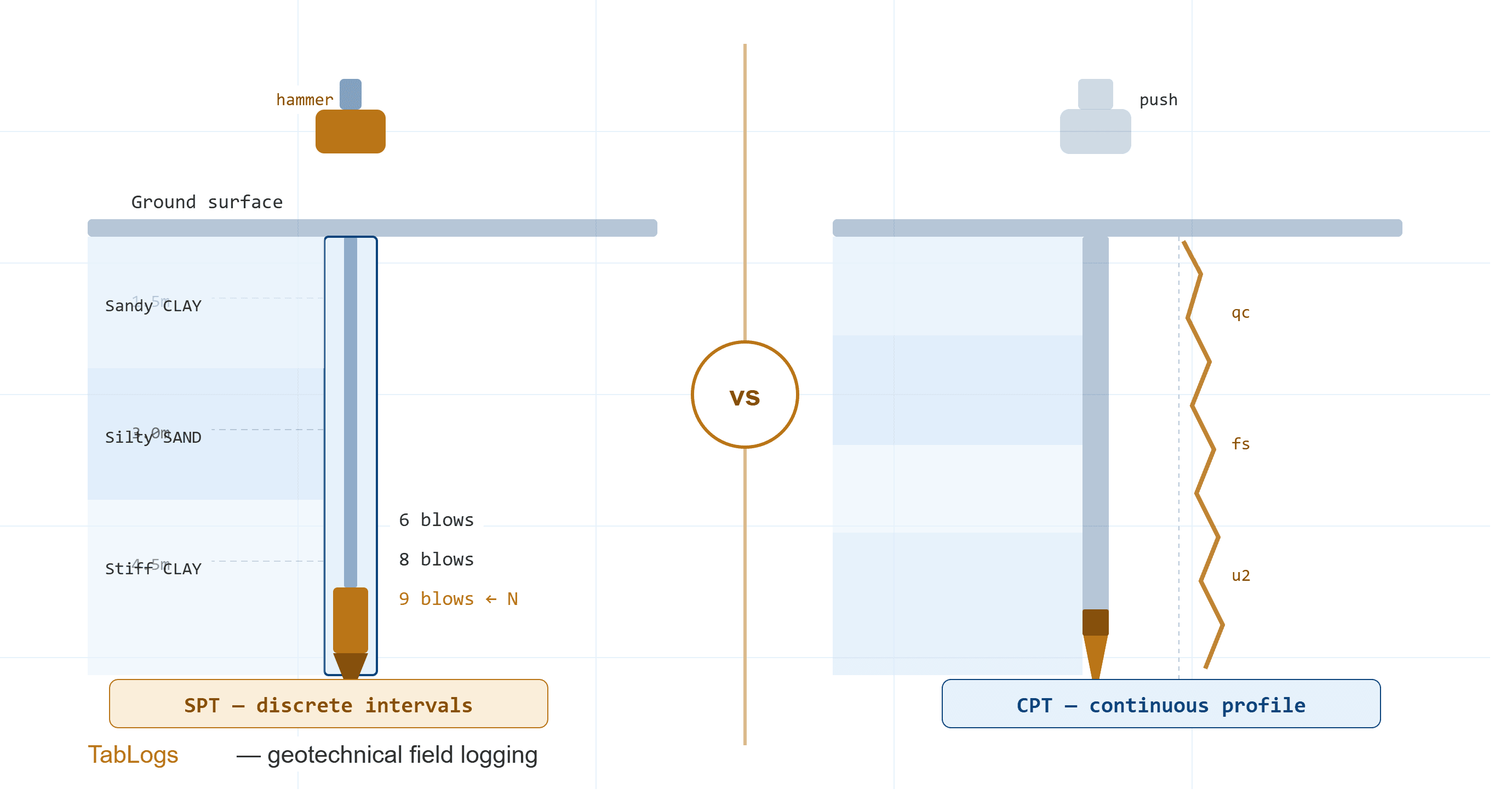
The Standard Penetration Test (SPT) and Cone Penetration Test (CPT) are the two most widely used in-situ tests in geotechnical site investigations. SPT measures soil resistance using a driven sampler and records blow counts at discrete depth intervals. CPT pushes an instrumented cone continuously into the ground and records tip resistance, sleeve friction, and pore pressure as a continuous profile. Both tests provide data on soil strength and layering, but they differ significantly in what they measure, how data is recorded, and when each is the better choice.
What is the Standard Penetration Test (SPT)?
The SPT is performed by driving a split-spoon sampler into the ground using a standard hammer and recording the number of blows required to advance the sampler 300mm. The result — the SPT N-value — is one of the most widely used indicators of soil density and strength in geotechnical practice.
SPT is governed by ASTM D1586 in the US and equivalent standards in other markets. The test also recovers a disturbed soil sample, which can be classified in the field using ASTM D2488 or sent to the laboratory for confirmation under ASTM D2487.
Key characteristics of SPT: performed at discrete depth intervals, typically every 1.5m or at layer changes; recovers a physical sample for classification; blow counts are recorded per 150mm increment and reported as N for the final 300mm drive; hammer energy correction factors (CE, CB, CR, CS) are applied in some design contexts to normalise N-values.
What is the Cone Penetration Test (CPT)?
The CPT pushes a cone-tipped probe continuously into the ground at a controlled rate, typically 20mm per second. Sensors in the cone measure tip resistance (qc), sleeve friction (fs), and — in the piezocone variant (CPTu) — pore water pressure (u2) as a continuous function of depth. CPT produces a high-resolution continuous profile of subsurface conditions without recovering a physical sample. It is governed by ASTM D5778 in the US and ISO 22476-1 internationally.
Key characteristics of CPT: continuous measurement with no depth gaps; no physical sample recovered; data recorded electronically and processed to derive soil behaviour type, relative density, and undrained shear strength; faster to execute than SPT on suitable ground; requires specialist equipment and interpretation software.
CPT vs SPT — key differences
| SPT | CPT | |
|---|---|---|
| Measurement type | Discrete intervals | Continuous profile |
| Physical sample | Yes - split spoon | No |
| Data output | Blow counts (N-value) | qc, fs, u2 as continuous logs |
| Standards | ASTM D1586 | ASTM D5778, ISO 22476-1 |
| Soil classification | Field and lab | Interpreted from soil behaviour type |
| Equipment | Drill rig and hammer | CPT rig and cone |
| Ground stability | Most soils and rock | Soft to medium soils — not gravel or rock |
| Speed | Slower | Faster in suitable ground |
| Depth capability | Deep | Typically limited by soil resistance |
| Best for | Mixed ground, sampling required | Soft soils, high-resolution profiling |
When to use SPT
SPT is the better choice when a physical sample is required for laboratory testing, when ground conditions include gravel, cobbles, or rock that would stop a CPT cone, when the project specification requires N-values for foundation design correlations, or when working in markets where SPT is the standard contractual requirement — including most US DOT and ASTM-governed projects.
SPT is also practical when the investigation involves deep boreholes where CPT push capacity would be exceeded.
When to use CPT
CPT is the better choice when continuous high-resolution profiling is required, when soft soil conditions make SPT impractical or unreliable, when stratigraphic correlation between multiple locations is needed at close depth intervals, or when pore pressure data is required for consolidation or liquefaction assessment.
CPT is faster and more repeatable than SPT in suitable ground and produces a cleaner data record for digital processing and geotechnical modelling.
How to record SPT and CPT data on a boring log
SPT results are recorded on the boring log at each test interval. Raw blow counts should be recorded by increment — for example 6/8/9 for three 150mm drives — alongside the final N-value, the test depth, hammer type, and any notes on refusal or unusual conditions. See the TabLogs boring log guide for full SPT recording guidance.
CPT data is typically recorded electronically by the cone equipment and delivered as a separate digital file (CPeT, CSV, or GEF format) rather than manually on a boring log. The CPT sounding reference and depth range are noted on the borehole or investigation log for cross-referencing.
Digital logging platforms like TabLogs allow SPT results to be captured directly on the boring log in the field, linked to sample records, and exported in AGS or DIGGS format alongside CPT sounding references for integrated reporting.
Frequently asked questions
What does SPT N-value mean?
The SPT N-value is the number of blows required to drive the split-spoon sampler the final 300mm of a 450mm drive. It is used as an index of soil density and strength in geotechnical design correlations.
What is a good SPT N-value?
SPT N-values vary by soil type. For sands, N below 10 indicates loose conditions; 10-30 medium dense; above 30 dense to very dense. For clays, N correlates with consistency rather than density. Always interpret N-values in the context of the soil description and local practice.
What does CPT stand for in geotechnical engineering?
CPT stands for Cone Penetration Test. The piezocone variant — CPTu — includes a pore pressure sensor and is the most commonly used form in modern geotechnical investigations.
Which is more accurate — CPT or SPT?
CPT produces a more consistent and repeatable dataset because it is electronic, continuous, and less affected by operator variability. SPT is inherently more variable due to hammer energy differences and borehole conditions. However, accuracy depends on what you are trying to measure — CPT cannot recover a sample, and SPT cannot match CPT's depth resolution.